

Why uncertainty matters in finance
Financial forecasts often look precise: a single revenue number, a single portfolio return, a single project cost. In reality, every input behind that number is uncertain. Sales volumes fluctuate, interest rates move, inflation surprises, and market returns swing. A “best guess” forecast hides this variability and can lead to poor decisions—such as underestimating cash shortfalls or overcommitting capital.
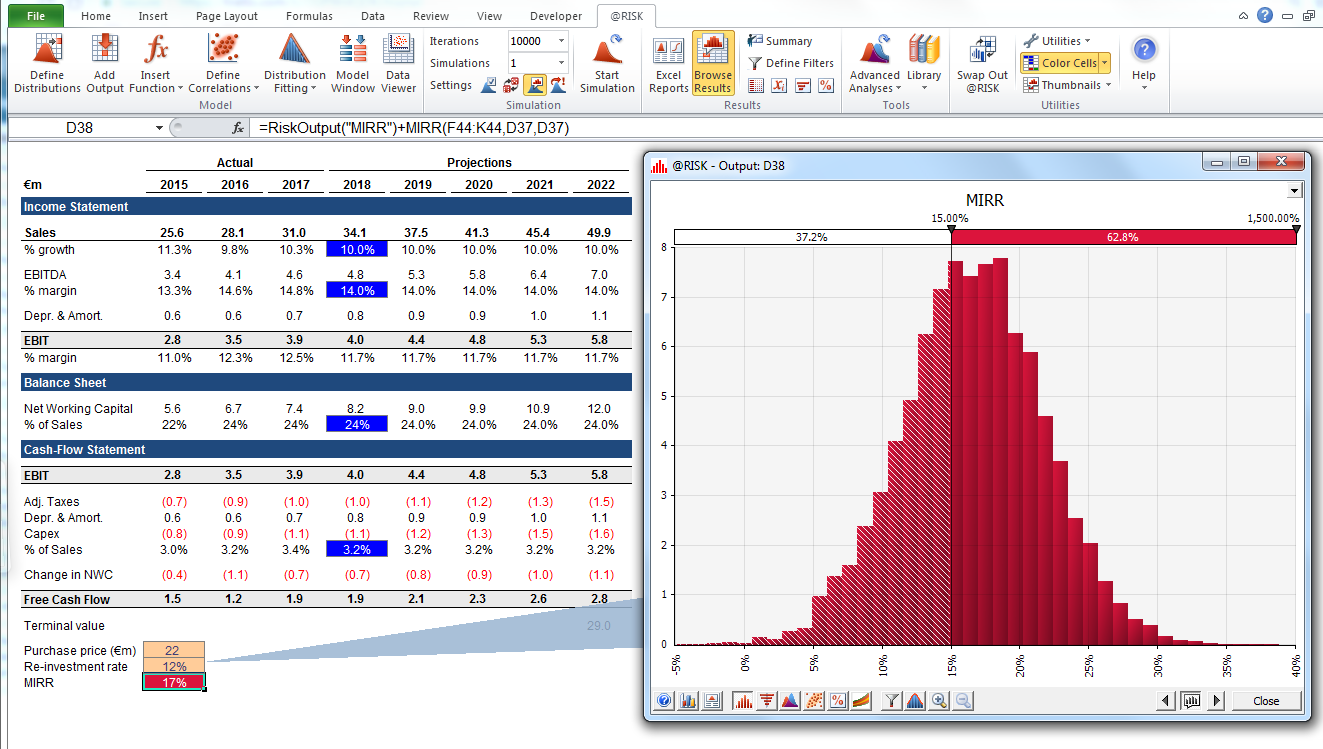
Monte Carlo Simulation tackles this problem by modelling many possible futures instead of just one. It replaces a single-point estimate with a distribution of outcomes, showing how often you might land in profit, how often you might lose money, and which inputs drive the most risk. If you are building practical forecasting skills in a data analyst course, this is one of the clearest ways to demonstrate how analytics improves decision-making under uncertainty.
What Monte Carlo Simulation actually does
At its core, Monte Carlo Simulation follows three steps:
- Define a financial model: for example, next year’s profit = revenue − costs − interest.
- Represent uncertain inputs with probability distributions: revenue growth might follow a normal distribution, default rates might be better represented with a beta distribution, and commodity prices might follow a lognormal distribution.
- Run thousands of trials: each trial randomly samples values for the uncertain inputs, calculates the output (profit, NPV, portfolio value), and stores the result.
After many trials, you get a distribution of outcomes rather than a single figure. This lets you answer more useful questions:
- What is the probability profit falls below zero?
- What is the 5th percentile outcome (a “bad but plausible” scenario)?
- What range of outcomes covers 90% of the simulations?
Where it’s used in real financial forecasting
1) Portfolio risk and return
Instead of assuming one expected return, Monte Carlo can simulate many market paths to estimate the likelihood of meeting a target value. It is commonly used to explore retirement outcomes, asset allocation choices, and downside exposure. You can simulate equity and bond returns, include correlations, and measure risk metrics like Value at Risk (VaR) and Conditional VaR (expected shortfall).
2) Project finance and NPV
For a project’s net present value, uncertain inputs include demand, price, operating costs, and discount rates. Monte Carlo helps you quantify the probability that the project generates a negative NPV, not just whether the “base case” is positive.
3) Credit and default risk
Banks and lenders use simulation to estimate expected losses under uncertain default rates, recovery rates, and macroeconomic conditions. Even a simplified version can show how sensitive a loan book is to changes in unemployment or interest rates.
These use-cases are frequently covered in applied finance modules within a data analysis course in Pune, because they combine business reasoning with statistical modelling and clear communication of risk.
How to build a Monte Carlo model step-by-step
Step 1: Choose the output metric
Pick a decision-focused measure: monthly cash balance, annual profit, portfolio value, or project NPV. The output should connect directly to a business question.
Step 2: Identify uncertain drivers
List the inputs that meaningfully move the outcome. For a cash-flow model, that may include customer churn, average order value, payment delays, and interest rates.
Step 3: Assign distributions (and justify them)
Avoid choosing distributions blindly. Use historical data where possible, or document assumptions when data is limited.
- Normal: useful for symmetric variability (with care, as it can generate negative values).
- Lognormal: useful for prices or values that cannot be negative.
- Triangular: practical when you only have min/most-likely/max estimates from domain experts.
- Beta: good for rates bounded between 0 and 1, like default probabilities.
Step 4: Model correlations
This is where many simulations go wrong. If you treat inputs as independent when they are linked, you can seriously understate risk. For example, revenue may fall when costs rise (inflation shocks), and equities may drop when volatility rises. Use correlation matrices or scenario-based dependency assumptions.
Step 5: Run, validate, and interpret
Run enough simulations (often 10,000+) for stable results. Validate by checking whether simulated inputs resemble real-world ranges and whether outcomes behave logically. Then interpret using:
- Percentiles (P5, P50, P95)
- Probability of crossing a threshold (e.g., cash < 0)
- Sensitivity analysis (which inputs explain most variance)
This is exactly the kind of end-to-end workflow that strengthens capability for learners in a data analyst course—because it blends modelling, computation, and decision storytelling.
Common pitfalls and how to avoid them
- Overconfidence in assumptions: A simulation is only as good as its input distributions. Document assumptions and revisit them.
- Ignoring fat tails: Markets often show extreme moves more frequently than a normal distribution predicts. Consider heavier-tailed distributions when appropriate.
- Treating correlation as optional: Correlations often determine the size of downside risk.
- Miscommunicating results: Present probabilities and ranges, not just averages. Decision-makers need clarity on downside likelihood.
Conclusion
Monte Carlo Simulation turns forecasting into a risk-aware process by showing a full range of financial outcomes and their probabilities. It helps you stress-test decisions, quantify downside risk, and identify the variables that matter most. Whether you are modelling a portfolio, evaluating a project, or estimating cash runway, the key is disciplined assumptions, realistic dependencies, and clear interpretation. For professionals sharpening practical forecasting skills through a data analysis course in Pune, Monte Carlo is a valuable method that connects statistics directly to financial decision-making under uncertainty.
Contact Us:
Business Name: Elevate Data Analytics
Address: Office no 403, 4th floor, B-block, East Court Phoenix Market City, opposite GIGA SPACE IT PARK, Clover Park, Viman Nagar, Pune, Maharashtra 411014
Phone No.:095131 73277




Leave a Reply